Para_sportCommGames1994-2022medal records
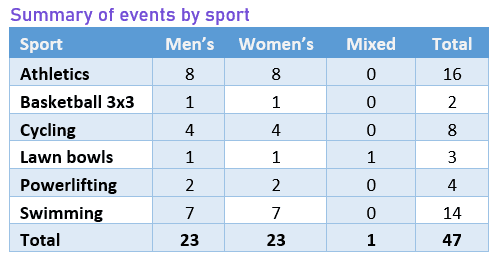
The 2026 Commonwealth Games have been scaled back by almost any measure – sports, athletes, events, venues, operating budget and spectator attendances – but one area that has seen growth, albeit modest, is the number of para sport events which are up from 43 in Birmingham four years ago to a record 47 in Glasgow. Hugely popular amongst athletes and audiences, para sport events are fully integrated into the program and medals count towards a nation’s overall total, and by the end of the Glasgow Games over 500 will have been awarded since 1994.
Here is a brief history of para sports at the Commonwealth Games. Click on the link at the top of this article for some selected medal records and statistics.
Auckland 1990
Two wheelchair track racing events – 1500m for men and 800m for women – were held as exhibition events at the Auckland 1990 Games. Although competitors represented their countries, they were not allowed to take part in the opening and closing ceremonies and were prevented from training at the athletics stadium by officials who were concerned their wheelchairs would damage the track.
The men’s 1500m race was won by New Zealand’s only six-time Paralympian Graham Condon, his final international appearance. Gold in the women’s 800m went to 16-year-old schoolgirl Louise Sauvage, who would go onto become a household name in Australian para sport.
Victoria 1994
Para events made their official debut at the 1994 Commonwealth Games in Canada with 55 athletes taking part in three sports: athletics, lawn bowls and swimming. They were originally designated as exhibition events but after a public outcry during the Games, the Commonwealth Games Federation ruled they would count towards the Games medal tally, but not the overall Games records. However, most record keepers now include them in the overall tally.
Despite chef de mission Arthur Tunstall causing a storm of controversy by suggesting the presence of disabled athletes was an embarrassment, Australia picked up two gold medals to Paul Wiggins in the men’s wheelchair marathon and 16-year-old Tasmanian swimmer Melissa Carlton in the women’s 100m freestyle multi-disability.
Manchester 2002
After an eight-year absence, para competitors – rebranded as Elite Athletes with a Disability (EAD) – returned to the Commonwealth Games with 10 events in five sports, including table tennis for the first time.
Canada’s Chantal Peticlerc won the women’s 800m wheelchair race ahead of Australian duo Louise Sauvage and Eliza Stankovic who would go on to compete at the Glasgow 2026 Games. Another notable performance was by Natalie du Toit who won gold in both the 50m and 100m freestyle multi-disability having represented South Africa as an able-bodied competitor four years earlier in Kuala Lumpur. They were the first of a record seven gold medals she would accumulate over three Games.
Melbourne 2006
Although lawn bowls was omitted, the Elite Athletes with a Disability (EAD) program saw further expansion to 12 events in four sports with around 200 athletes taking part.
Australia topped the medal table with 4 gold, spearheaded by Matthew Cowdrey who won the men’s 50m and 100m freestyle S9. Other standout performances were by Chantal Peticlerc, who had made history at the opening ceremony as the first athlete with a disability to carry Canada’s flag, who won her second consecutive women’s 800m T54. South Africa’s Natalie du Toit successfully defended both women’s freestyle titles in the pool and England’s Sue Gilroy also defended her wheelchair table tennis title from Manchester. Richard Nicholson (athletics) also became the first to compete in two para sports having represented Australia in powerlifting in the previous Games in Manchester.
Delhi 2010
In Delhi, 15 para events featured on the program in four sports, with women’s powerlifting (open bench press) making its first appearance.
Once again, Australia topped the medal table with 5 gold and 13 medals. Nigeria asserted their dominance in powerlifting when they clean swept the podium in both the men’s and women’s events. In her fourth Games (but third as a para-athlete), South African swimmer Natalie du Toit became the first para-athlete to win three gold medals at a single Games winning her third successive 50m and 100m freestyle titles, as well as 100m butterfly S9.
Glasgow 2014
Lawn bowls returned to the program with the first mixed para event in Commonwealth Games history – the B2/B3 pairs for visually-impaired athletes. The triples B6/B7/B8 for athletes with a physical disability was an open event and New Zealand’s Lynda Bennett became the third woman in Commonwealth Games history to win a medal (silver) competing against men in an open event.
Australia and England both won 5 gold, but Australia was ranked higher because they won 19 medals against 12.
Gold Coast 2018
Once again, a new record was set when the Gold Coast Games hosted nearly 300 para-athletes and 38 medal events across seven sports. Table tennis (wheelchair singles) returned to the program – also adding an event for men – triathlon made its debut with an event for wheelchair athletes, while athletics and swimming doubled the number of events for para-athletes.
After winning athletics bronze in the T54 1500m in Manchester, Jade Jones (England) became the first para-athlete to win medals in two sports when she won gold in the women’s PTWC triathlon. Also creating history was bronze medallist Diane Roy (Canada) in her fifth and final appearance, the most for a para-athlete. Nigeria’s Esther Oyema won her third women’s powerlifting gold, while Melissa Tapper’s table tennis gold in the women’s TT6-10 singles enabled her to become the first athlete to win medals in able-bodied and para sports at the Commonwealth Games.
Birmingham 2022
Birmingham 2022 set another Commonwealth Games record by hosting up to 300 para-athletes and 43 medal events across eight sports, including wheelchair 3×3 basketball, the first time a para team sport on the program. Triathlon switched to a visually-impaired category.
Australia took a record 12 gold and 34 medals, with the highlight being Madison de Rozario successful defence of her women’s T54 1500m and marathon events, becoming the first para-athlete to win four gold medals in track and field. Other notable performances were by Scottish lawn bowlers Rosemary Lenton (alongside Pauline Wilson), 72 and George Miller (director for Melanie Inness), 75, who became the oldest gold medallists in Commonwealth Games history when they won the para women’s pairs and para mixed pairs respectively.
Glasgow 2026
Despite triathlon and table tennis being dropped from the program – reducing the number of para sports to six – the inclusion of additional events in athletics, cycling and swimming means that a record 47 gold medals are up for grabs at Glasgow 2026.